← All apps

The Questly app icon, two children and a gold star

Questly

Turn chores into something your kids want to do. Questly gives every job a picture, every reward a price, and both parents the final say, all in an app made just for your family.

$150 Regular price $299

One time price. No subscription, no monthly fees.

Launch price for up to two children and two parents, and $50 for each extra child. Pay once, and Questly is yours to keep. Two years of support and one free character update included. After that, support is optional at $50 a year.

Claim the launch price See it in action

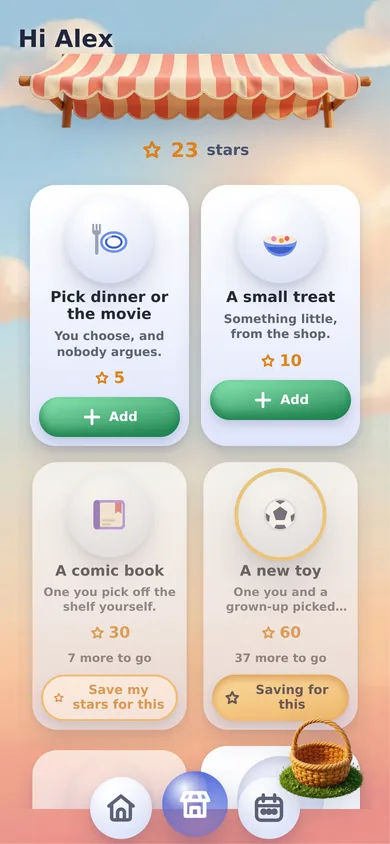
A shop under a striped awning showing 23 stars and four reward cards: Pick dinner or the movie at 5 stars and A small treat at 10 with green Add buttons, and A comic book at 30 and A new toy at 60 with buttons for saving stars towards them.
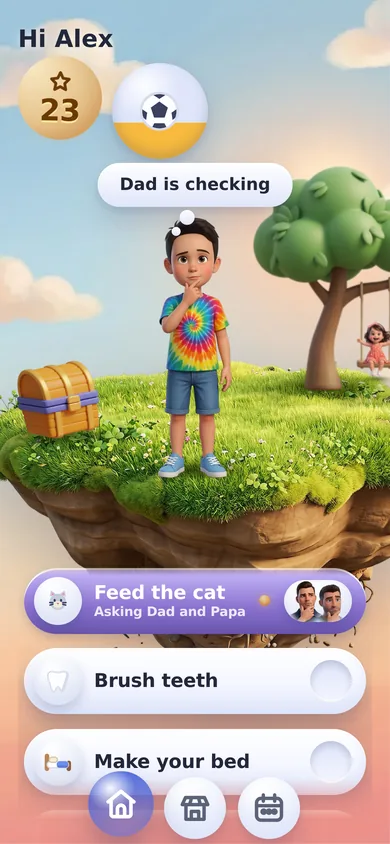
A child's cartoon character stands on a floating grass island under a pale morning sky, with a gold coin showing 23 stars and a saving goal above, a treasure chest alongside, and a list of jobs below reading Feed the cat, Brush teeth and Make your bed.
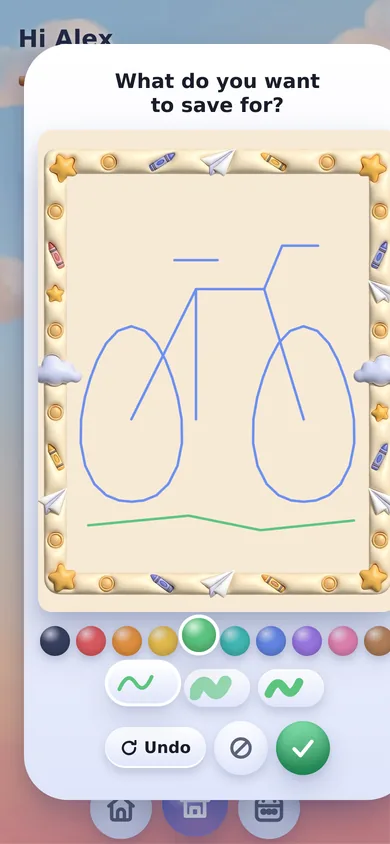
A sheet of cartoon stationery headed What do you want to save for, with a blue line drawing of a bicycle and a green line of ground under it, a row of ten colour buttons, three pen shapes and an Undo button below.
Understood at a glance

Detailed, colorful visuals that every child recognizes instantly, whether they read yet or not.

Every job, reward and button is a clear picture first and a word second, and your own family appears as the characters. Kids know what to do without asking, and parents see everything in one tap. It runs on the phones, tablets and wall screen you already own.

Why families choose Questly

Your kids are the heroes

Every child and parent is drawn as a cartoon character, so the app feels like theirs from the first tap.

Parents stay in control

Stars only land when a parent approves, and purchases need both of you. Nothing is claimed that was not done.

Real money lessons

Kids earn, save and spend on real rewards you choose, and learn to budget by doing it.

Pay once, keep it

No monthly fees, no ads and nothing to buy inside the app. Two years of support included.

A child's cartoon character stands on a floating grass island under a pale morning sky, with a gold coin showing 23 stars and a saving goal above, a treasure chest alongside, and a list of jobs below reading Feed the cat, Brush teeth and Make your bed. The same island screen with the character holding their chin, a speech bubble reading Dad is checking, and the Feed the cat job now a purple bar reading Asking Dad and Papa with both parents' faces on it. The parents' screen headed Waiting on you, with a Feed the cat request showing its standard, and an open menu titled Send it back listing five amber answers: Started not finished, Needs to show a parent, Needs help, Done not done well, and Claimed before the time. A shop under a striped awning showing 23 stars and four reward cards: Pick dinner or the movie at 5 stars and A small treat at 10 with green Add buttons, and A comic book at 30 and A new toy at 60 with buttons for saving stars towards them. A checkout card with the character jumping with both arms up, a note reading Look what you did, the jobs the stars came from, both parents' faces beneath it, two basket items, the sums You have 23, This costs 15, You keep 8, and a green button reading Ask Dad and Papa. A sheet of cartoon stationery headed What do you want to save for, with a blue line drawing of a bicycle and a green line of ground under it, a row of ten colour buttons, three pen shapes and an Undo button below.
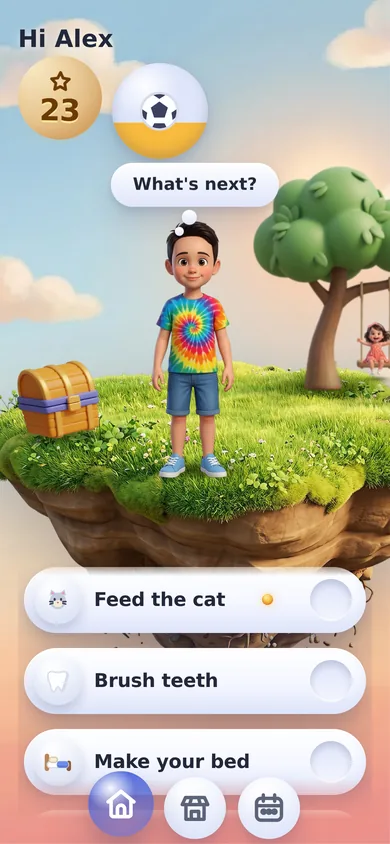
A child's cartoon character stands on a floating grass island under a pale morning sky, with a gold coin showing 23 stars and a saving goal above, a treasure chest alongside, and a list of jobs below reading Feed the cat, Brush teeth and Make your bed.
Every morning

Kids know exactly what to do

Your child opens Questly to today's jobs, each shown as a clear picture, with the stars they have saved and the goal they are working toward right above. No menus, no reading required and no getting lost, so mornings run smoother.

The same island screen with the character holding their chin, a speech bubble reading Dad is checking, and the Feed the cat job now a purple bar reading Asking Dad and Papa with both parents' faces on it.
When a job is done

You stay in control of every star

Your child taps a finished job and both your phones buzz. Stars only arrive when a parent approves, so every reward is earned and nothing gets claimed that was not done.

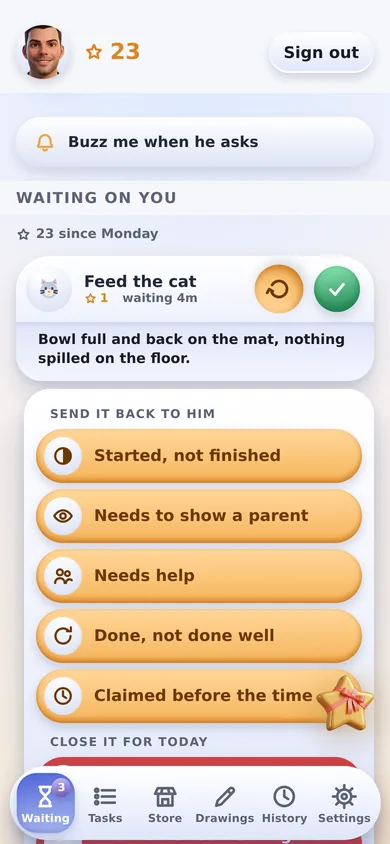
The parents' screen headed Waiting on you, with a Feed the cat request showing its standard, and an open menu titled Send it back listing five amber answers: Started not finished, Needs to show a parent, Needs help, Done not done well, and Claimed before the time.
On your phone

Answer in seconds, from anywhere

See what is waiting, check it against the standard you agreed on, and approve with one tap. Not quite there? Send it back with a quick reason and it returns to their list as "not yet". Every answer is saved, so there is never an argument about who said what.

A shop under a striped awning showing 23 stars and four reward cards: Pick dinner or the movie at 5 stars and A small treat at 10 with green Add buttons, and A comic book at 30 and A new toy at 60 with buttons for saving stars towards them.
The reward shop

Rewards they actually want

Fill the shop with real rewards at prices you set, from picking the movie to a new toy. Kids fill a basket, watch their stars add up, and choose to save for the bigger things. It is budgeting they learn by doing.

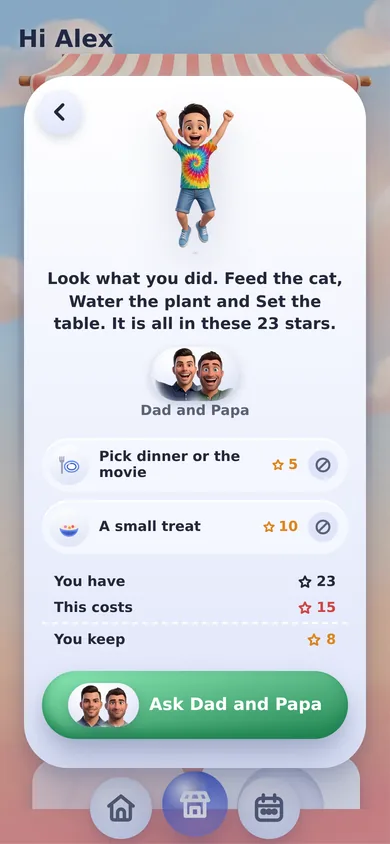
A checkout card with the character jumping with both arms up, a note reading Look what you did, the jobs the stars came from, both parents' faces beneath it, two basket items, the sums You have 23, This costs 15, You keep 8, and a green button reading Ask Dad and Papa.
At checkout

Every purchase is a lesson

Before buying, the checkout shows the jobs that earned the stars, what it costs and what is left. Both parents approve together, so there is never a "but Mom already said yes."

A sheet of cartoon stationery headed What do you want to save for, with a blue line drawing of a bicycle and a green line of ground under it, a row of ten colour buttons, three pen shapes and an Undo button below.
Wish lists

Kids draw what they want

No typing needed. Your child draws their wish, you talk it over together, and with a name and a price it appears in their shop, ready to save for.

Built on what pediatricians recommend

Every rule in Questly follows guidance from pediatricians and child development research, so the habits it builds are the ones experts recommend. Each one is linked to its source below.

A tap asks. A parent pays.

The American Academy of Pediatrics calls a parent's attention "the most powerful tool for effective discipline" and advises noticing good behavior and pointing it out.1 The CDC says specific praise works best "because your child knows exactly what you like."2 So in Questly the reward always comes from a person who saw the job, never from the app.

Both parents, one answer

The American Academy of Child and Adolescent Psychiatry advises that "parents should begin by talking to each other" about rules, and calls consistency and predictability "the cornerstones of discipline."3 Researchers who study co-parenting treat agreement between parents as one of its core parts.4 Both parents get the same screen and the same choices, and a purchase needs both of you.

Done is agreed in advance

Each job carries a standard you write: what done looks like. The same guidance from AACAP says parents and child "should decide together what the rewards and consequences will be,"3 and an author of the AAP's discipline policy advises setting rules in advance and being consistent in following through with them.8

Three answers, never silence

Every request gets yes, "not yet" with a reason, or no. The AAP advises "praising success and good tries."1 In a series of experiments, children praised for their effort kept trying and did better after a setback than children praised for being smart,5 and Carol Dweck, who led that work, describes a grade of "not yet" as telling a child they are on a learning curve, not that they failed.6

Right away, on both phones

The CDC notes that rewards that happen right after a behavior are best.2 The moment your child asks, both your phones buzz, and the stars can land while the job is still fresh.

No fines, no deductions

The AAP points parents to healthy forms of discipline such as setting limits, redirecting and setting expectations,7 and an author of that policy says "it's best to begin with the premise of rewarding positive behavior."8 Stars in Questly only go up. The only way down is a parent undoing their own mistaken approval.

Kindness is never on the price list

In a classic study, preschoolers who drew in order to get a promised award later chose drawing less often than children who received the same award as a surprise or no award at all.9 A review of 128 experiments found that unexpected rewards did not have that effect.10 So kindness and initiative cannot be asked for in Questly. A parent can only grant them, unprompted, as a one-star moment.

No streaks, no lures, no ads

A study of the apps used by 160 children aged three to five found manipulative design, such as fake time pressure and rewards for coming back, in most of them.11 Questly has no streaks, no countdowns, no ads and nothing to buy inside it. It is only open as long as a job takes.

Stars that buy real things

The Consumer Financial Protection Bureau found that the skills behind good money habits, like planning ahead and self-control, start forming between ages three and five, with money habits taking shape between six and twelve.12 A saving goal, a basket that shows what is left, and a checkout that names where the stars came from give those skills somewhere to practise.5

These sources shaped how Questly works. They are about children and parenting in general. None of them studied Questly, and Questly is not a treatment, therapy or medical device.


Everything included in one $150 payment

Made for your family

  • Your children drawn as cartoon characters, in five poses each, and both parents too
  • Your names throughout, including what your children call you
  • Your chores, routines and rewards set up with you
  • Installed on your phones, tablets and wall screen

Two years of support

  • Help by email whenever something is not right
  • Fixes and improvements to Questly as we make them
  • One free character update, for example as your children grow
  • After two years Questly keeps working. Support continues for $50 a year if you want it.

Private by design

  • Your family's own separate app and database, shared with no other family
  • Your family's characters only load for your signed in family, and the app's icon and sign in screen show no one
  • No ads, no tracking, nothing sold
  • Nothing to pay to keep using it, and nothing to buy inside the app
  • Read the Questly privacy policy

Pay once. Save for years.

The most popular family chore and reward tools charge every month or year, and some need a screen you buy first. Over five years, Questly costs up to $898 less.

ProductWhat you pay2 years5 yearsYou save with Questly over 5 years
GreenlightDebit card and money app for kids, with chores$5.99 to $19.98 a month$143.76 to $479.52$359.40 to $1,198.80Up to $898.80
Hearth Display with Family Membership27 inch family display with routines and rewards$699, then $155.52 every two years$854.52$1,087.80$787.80
Skylight Calendar 2 with Plus15 inch wall calendar with chores; rewards need Plus$299.99, then $79 a year$457.99$694.99$394.99
Joon PremiumChores game where kids care for a virtual pet$89.99 a year$179.98$449.95$149.95
QuestlyMade for your family, with your children as the characters$150 one time, then optional support at $50 a year$150$300 with support every year, or $150 withoutLowest cost

Sorted from the most expensive over five years. Prices as listed on each company's own website on October 15, 2026, in US dollars before tax, and they may have changed since: Greenlight, Joon (as reported by ChoosingTherapy), Skylight, Hearth. Five year costs assume today's prices continue, and savings compare against Questly with support renewed every year ($300). Greenlight moves real money and includes a debit card, and Skylight and Hearth include a screen, which Questly does not. Questly's price is for setup and support, and does not include devices. Greenlight, Joon, Skylight and Hearth are trademarks of their owners, who are not affiliated with Brightmade Studios.

Lock in the $150 launch price

One time, not monthly. The regular price is $299. Tell us about your family today and your quote holds for 30 days.

Get Questly

Questions

What devices does it run on?

Any recent iPhone, iPad, Android phone or tablet, or computer with an up to date web browser. Questly is installed to the home screen like an app. On iPhone and iPad, notifications need iOS or iPadOS 16.4 or later, and Questly added to the Home Screen.

How many children can use it?

The launch price covers up to two children and two parents, each with their own sign in. Each extra child is $50, which includes their character, their sign in and setting up their chores. You can add a child later for the same price.

What do you need from us?

Your first names (or nicknames, if you prefer), what your children call you, the chores and rewards you want to start with, and photos or a description of each person so we can draw the characters. A parent also gives us written consent before we set up your children's sign ins. Everything else we set up for you.

Does it use real money?

No. Stars are your family's own currency, and the rewards are things you give. You can set what a dollar is worth in stars so a reward's price means something, but Questly never holds or moves money.

What happens after two years?

Questly keeps working, with nothing more to pay. If you want help, fixes and improvements to continue, support renews for $50 a year. It is your choice, and we will remind you before your support period ends. The details are in the Questly terms.

What is a character update?

Once during your two years, we redraw the characters for the people already in your Questly, for example when your children have grown or changed their look. It is free.

Who can see our family's information?

Only your family, and Brightmade when we are helping you. Each family's Questly has its own separate database. The only thing Questly keeps to identify a child is a first name or a nickname you choose, and the photos used to draw the characters are deleted once you approve them. The characters themselves are never public files: they are only sent to someone signed in to your Questly, and the icon and sign in screen show no one. We never sell anything or use it for ads. See the Questly privacy policy.

What if it is not right for us?

Tell us within 14 days of your Questly being delivered and we will refund you in full. The Questly terms have the details.

Get Questly for your family

Leave your details and we will be in touch to talk it through. Nothing is charged until you have said yes to a written quote.

  • We call or email to hear about your family
  • You get a written quote, held for 30 days
  • Once you say yes, we draw your characters and set everything up with you

We use these details only to contact you about Questly. See our privacy policy. The referral discount follows the referral terms.

Sources

  1. American Academy of Pediatrics. "What's the Best Way to Discipline My Child?" HealthyChildren.org, 2018. healthychildren.org
  2. Centers for Disease Control and Prevention. "Tips for Using Praise and Rewards." Essentials for Parenting Toddlers and Preschoolers. cdc.gov
  3. American Academy of Child and Adolescent Psychiatry. "Discipline." Facts for Families No. 43, updated June 2025. aacap.org
  4. Feinberg, M. E. (2003). The internal structure and ecological context of coparenting: A framework for research and intervention. Parenting: Science and Practice, 3(2), 95-131. doi.org/10.1207/S15327922PAR0302_01
  5. Mueller, C. M., and Dweck, C. S. (1998). Praise for intelligence can undermine children's motivation and performance. Journal of Personality and Social Psychology, 75(1), 33-52. doi.org/10.1037/0022-3514.75.1.33
  6. Dweck, C. (2014). "The power of believing that you can improve." TEDxNorrkoping. ted.com
  7. Sege, R. D., Siegel, B. S., and AAP Council on Child Abuse and Neglect, Committee on Psychosocial Aspects of Child and Family Health (2018). Effective discipline to raise healthy children. Pediatrics, 142(6), e20183112. doi.org/10.1542/peds.2018-3112
  8. American Academy of Pediatrics. "AAP Updates Corporal Punishment Policy." HealthyChildren.org, November 5, 2018. healthychildren.org
  9. Lepper, M. R., Greene, D., and Nisbett, R. E. (1973). Undermining children's intrinsic interest with extrinsic reward: A test of the "overjustification" hypothesis. Journal of Personality and Social Psychology, 28(1), 129-137. doi.org/10.1037/h0035519
  10. Deci, E. L., Koestner, R., and Ryan, R. M. (1999). A meta-analytic review of experiments examining the effects of extrinsic rewards on intrinsic motivation. Psychological Bulletin, 125(6), 627-668. doi.org/10.1037/0033-2909.125.6.627
  11. Radesky, J., Hiniker, A., McLaren, C., Akgun, E., Schaller, A., Weeks, H. M., Campbell, S., and Gearhardt, A. N. (2022). Prevalence and characteristics of manipulative design in mobile applications used by children. JAMA Network Open, 5(6), e2217641. pmc.ncbi.nlm.nih.gov
  12. Consumer Financial Protection Bureau (2016). Building blocks to help youth achieve financial capability: A new model and recommendations. consumerfinance.gov